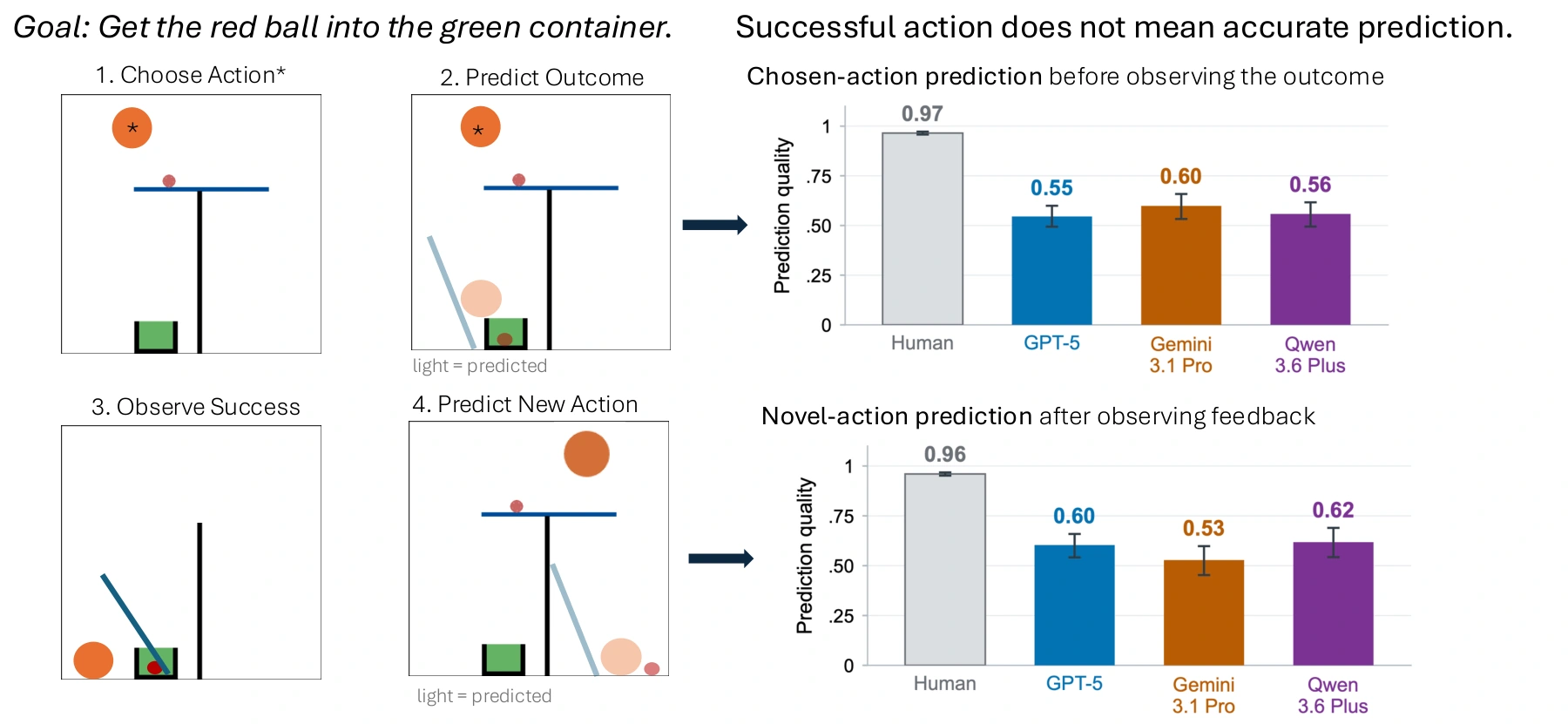
Evaluations of large multimodal models (LMMs) often conflate behavioral task success with true physical understanding. However, classical accounts of “world models” motivate evaluating three interconnected capacities: planning, prediction, and transfer to novel actions. Because current benchmarks typically test these three abilities in isolation, they can obscure how these capacities relate within the same models and tasks. In this paper, we propose a joint evaluation protocol to test whether LMMs acquire a more complete and consistent understanding of the physical world.
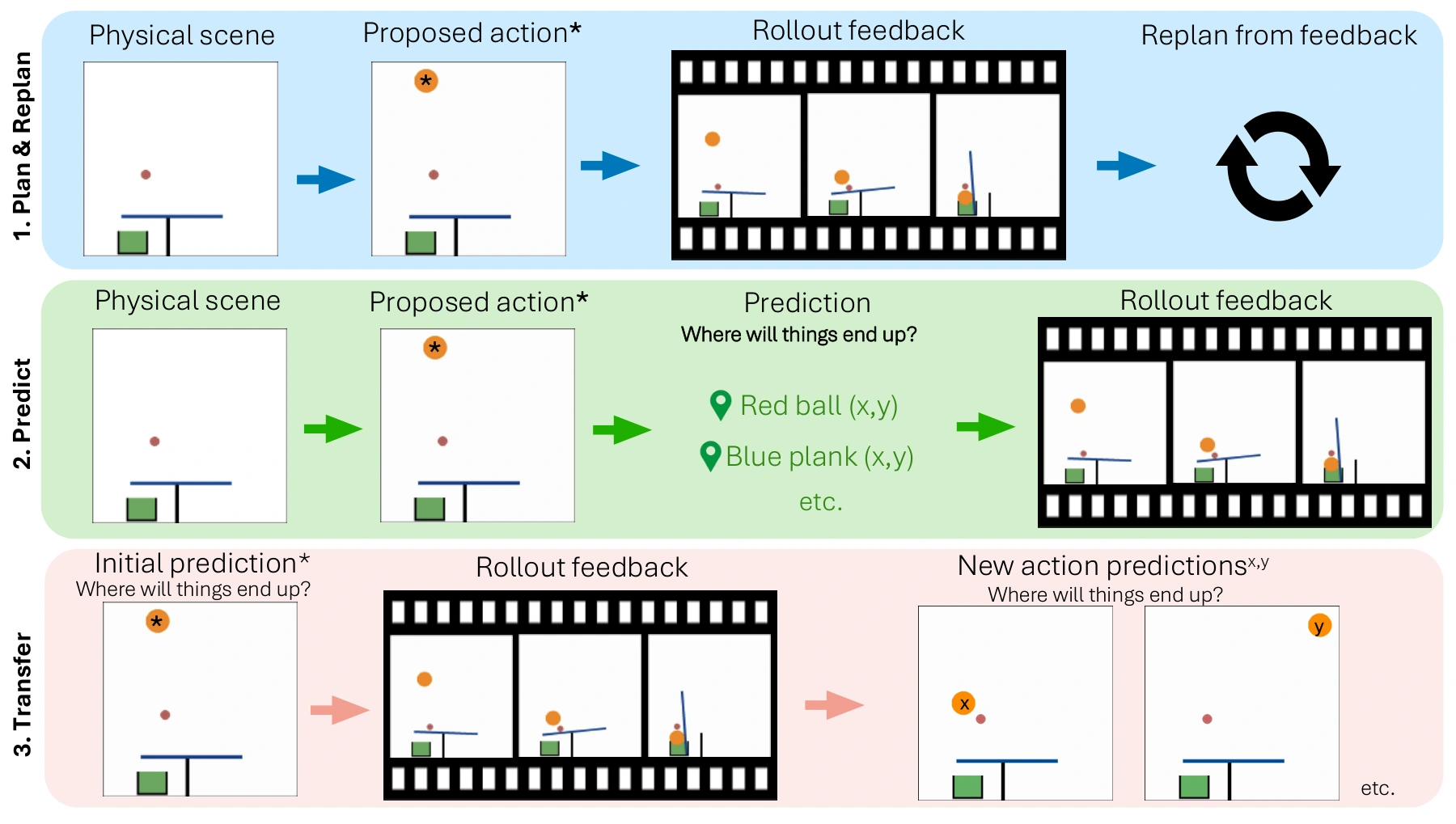
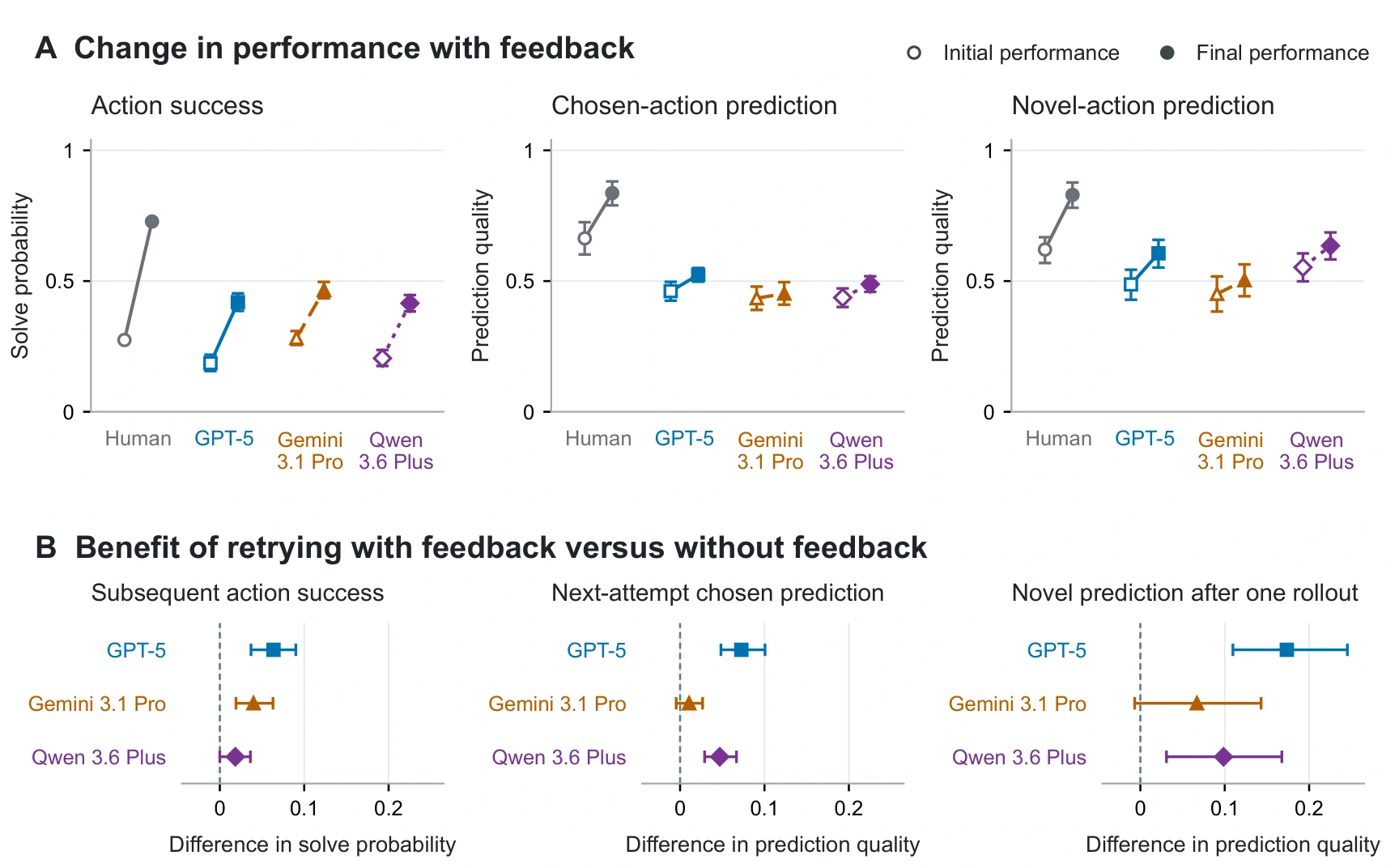
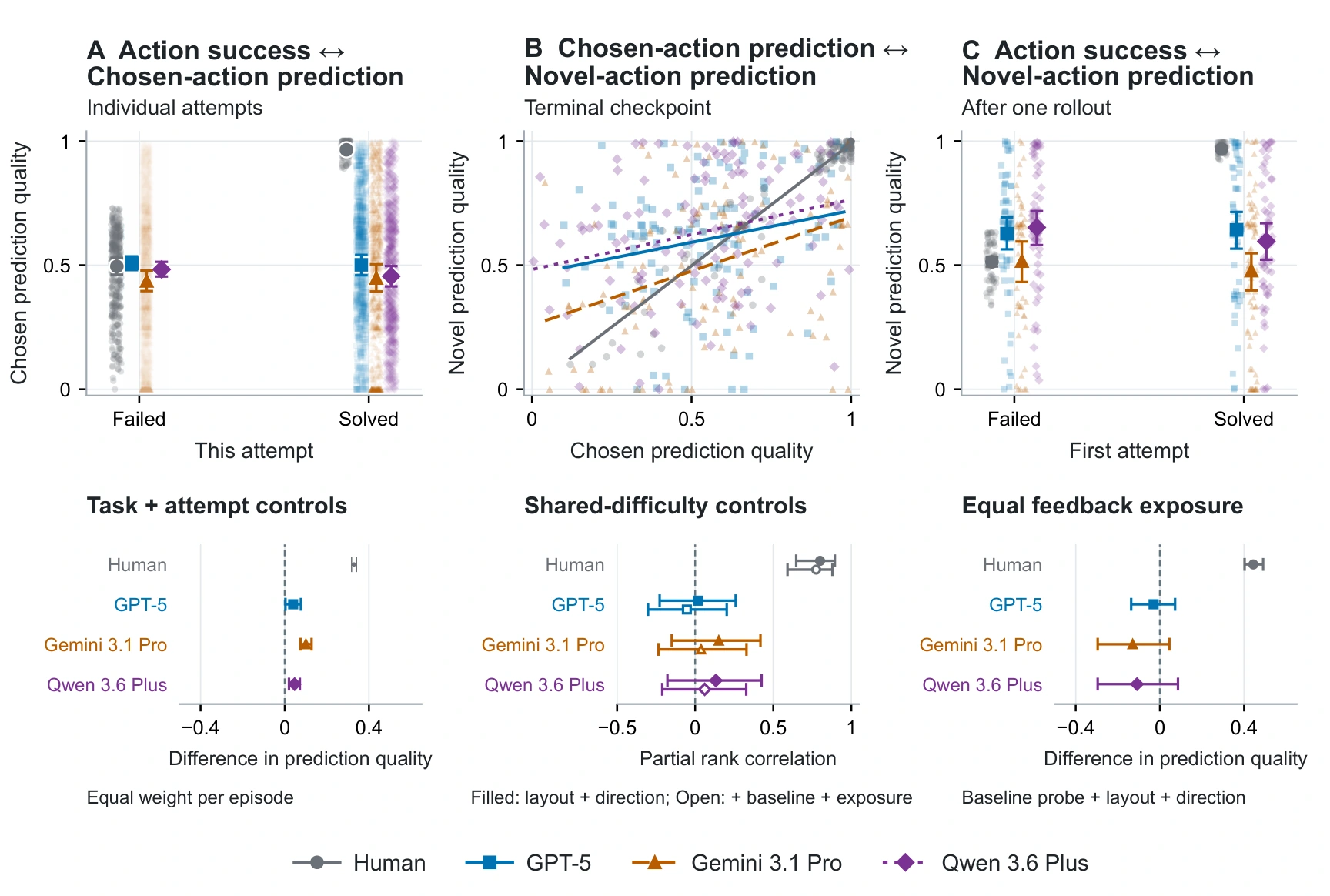
Using a suite of virtual physics-based puzzles, models are tasked with placing a tool in a scene to alter its dynamics, iteratively revising their placements based on visual feedback. By testing the same models on the exact same tasks, we uncover an uneven correspondence between acting and knowing. While LMMs can sometimes solve diverse physical goals under an interactive action-feedback protocol, their successful actions are often accompanied by inaccurate predictions of their consequences. Models show weak and inconsistent prediction of the consequences of their own proposed actions, and their predictive transfer to new actions is partial and inconsistent compared to humans. Ultimately, we show that even when models act successfully, the correspondence among planning, prediction, and transfer remains uneven and model-dependent. We therefore argue that benchmarks for LMMs should not measure task success alone, but should jointly evaluate planning, prediction, and transfer.
Models place a tool in a physics scene, predict where objects will end up, and use the observed outcome to choose another placement. We also test how they predict the effects of untried placements.
@inproceedings{yiu2026acting,
  title={Acting Without Knowing: Multimodal Models Do Not Yet Understand the Consequences of Their Actions},
  author={Yiu, Eunice and Ginosar, Shiry and Gopnik, Alison and Murphy, Kevin and Allen, Kelsey},
  booktitle={Advances in Neural Information Processing Systems},
  year={2026},
  url={https://neurips.cc/virtual/2026/poster/139556}
}